Rukia Bakari, PhD Women, Peace and Security, Faculty of History, Arts and Area Studies – Institut für Afrikanistik, Universität Leipzig, 2017-2021
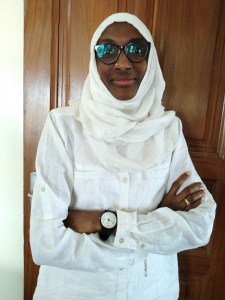
I relocated with my family to Dakar, Senegal, from Nairobi, Kenya in 2011. Being an Anglophone speaker, it was a challenge to settle in a Francophone environment. Looking for work with my limited working French was an uphill task and for two years I had to contend with offering language classes to young Senegalese students. I had completed a masters degree at the University of Nairobi a couple of years before and had been working on issues of Gender and development, particularly on issues of women accessing education and social cum legal justice in conflict situations. With my background as a lawyer, I am passionate about finding ways to help women access legal aid and was therefore able to work with disadvantaged women in poor neighborhoods in Nairobi.
It was in 2014 when I decided that I will pursue a PhD in the field of Political Science. I have always wanted to teach and do research, and I believe that furthering my studies would help me achieve this. The challenge was that I had no scholarship or enough savings to support this ambition. I also had an 8 year old son that I had to consider in the equation. At that time my father was living and teaching in Turkey and so proposed that if I raised some money, he would top up the rest of what I needed. And thus, thanks to family support, I began my PhD journey in Turkey. However, two years into my studies, I had to unexpectedly terminate my studies due to unforeseen circumstances.
After leaving Turkey, discouraged but not defeated, I explored other options of continuing my studies and Germany for me was the country that offered a glimpse of hope. Education is basically free (tuition fees), but one has to have at least 10,000Euros per year for sustenance. I therefore weighed my options and applied in three different universities, eventually getting accepted at the University of Leipzig in the faculty of History, Arts and Area Studies. I was also very lucky to have found a professor who was willing to become my supervisor.
I was again faced with the dilemma of looking for funding. I contacted my then Supervisor, Prof. Dr. Ulf Engel, to request for supervision, and in the process informed him of the financial challenges I was facing. Offering a helping hand, he, together with the coordinator of the Graduate School of Global and Area Studies, made available funds from special programs such as the IPD4ALL and small research grants for visiting scholars. This assistance, though not a significant amount, was very crucial as it enabled me to have more time to commit myself to writing my dissertation. In reality, I funded 80 percent of my studies in my three and a half years’ stay in Leipzig.
The availability of scholarships especially for researchers under the age of 35 years through the German Academic Exchange Service (DAAD) program provides an opportunity for young scholars from developing countries to pursue postgraduate studies in German universities. However, in my case, I was what may be considered a mature student. I was already 40 years old and was ineligible for any scholarship. I realized that it is easier for younger students to get funding than older students, which forces older students to fail or hesitate to pursue their dreams because of the lack of money.
Experience of academic research
Having pursued my undergraduate and master’s degrees in African universities where access to academic journals and publications is limited, the opportunity to have studied in the University of Leipzig was a totally different and enriching experience. The university availed more academic resources with access to highly rated scientific journals and books. This situation created an enabling environment for studying and doing research, especially considering how thoroughly one has to review the literature before settling on a research question. The graduate school also organized different colloquia and research-enhancing seminars which provided us with reading, writing and critical thinking skills, all important tools for academic excellence.
Post PhD transition
I am just settling down a few weeks after my oral defense and still considering various options for the future. I would absolutely love to teach and also continue working with women in their grassroots domains to create a more socially just society.
Advice for young and older women who are considering pursuing a PhD?
I would say that be very sure you want to really pursue the degree because you must have the endurance to withstand the pressure and the passion to fulfill your goal. I hope my story can inspire you!
 Dr. Sis
Leave a comment